Effective regulation protects the rights and safety of citizens, supports fair markets and ensures the delivery of public goods and services meets defined standards.
Background
Regulation is distinct from direct government provision or commissioning of services, because it relies on using incentives and sanctions to drive behaviour change in individuals or organisations outside of government’s direct oversight.
When regulation fails, it can have severe consequences for public finances, public safety, the economy as a whole or the environment.
The regulatory landscape in Jersey has developed over time, sometimes in response to specific events. There are a number of independent bodies set up to deliver regulatory functions, for example the Jersey Care Commission and the Jersey Competition Regulatory Authority. The States of Jersey website sets out areas of regulated activity across Jersey covering services ranging from agriculture to waste management. For some services, regulation is provided by an independent body, but for other services, for example construction, regulatory functions are undertaken by Government, or by Government contracting with a third party to provide regulatory services to the Island.
Effective regulation requires:
- Clarity and simplicity: regulations should be clear and straightforward, making it easy for individuals and organisations to understand their obligations. This reduces compliance costs and enhances adherence to the rules.
- Proportionality: the regulatory approach should be proportionate to the risks involved. This means that the level of regulation should correspond to the potential likelihood and impact of non-compliance, ensuring that resources are allocated efficiently.
- Consistency: regulations should be consistent across different sectors and over time. This helps build trust and predictability in the regulatory environment, allowing businesses and individuals to plan accordingly.
- Stakeholder engagement: effective regulation involves engaging with stakeholders, including businesses, consumers, and civil society, to gather input and feedback. This collaborative approach can lead to better-designed regulations that meet the needs of all parties involved.
- Monitoring and enforcement: there should be robust mechanisms for monitoring compliance and enforcing regulations. This includes having the necessary resources and authority to take action against non-compliance, which is crucial for maintaining the integrity of the regulatory framework.
The full costs of regulation go beyond the operating costs of regulators. Effective regulation maximises the benefits while minimising compliance costs and unintended consequences.
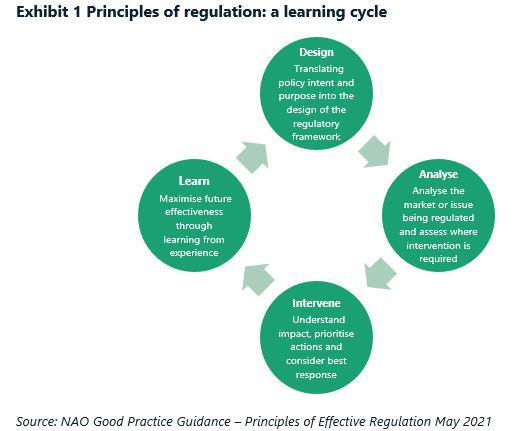
The UK National Audit Office (NAO) Good Practice Guidance Principles of Effective Regulation (May 2021) sets out the four principles of effective regulation (Exhibit 1).
Objectives of this audit
The audit’s overall objective is to evaluate the current landscape of regulation in Jersey to identify whether there are any overlaps or gaps in the design of regulation to achieve public policy aims in an effective way.Scope
Scope
The audit will focus on the design of regulation and whether the design supports the delivery of effective regulation. It will not seek to analyse the markets or issues being regulated or consider the intervention mechanisms being used in practice.
The areas that will be considered include regulation provided through Government departments, provided through the establishment of independent entities and commissioned from other sources. The audit will also assess the rationale where a decision has been taken not to regulate a sector or public service area.
Audit approach
This audit will use a:
- result-oriented approach (have the States of Jersey achieved their objectives with the design of regulation?); and
- problem-oriented approach (to what extent can the States of Jersey address the design of current arrangements to deliver effective regulation?).
The audit will commence with an initial documentation request and a questionnaire survey to identify what is regulated, how it is regulated and to assess the results of any relevant previous reviews. The findings of the document review and survey will be followed up by interviews with key officers and potentially with other stakeholders.
If the document request or survey identify areas of regulated activity where an independent review has been commissioned by the States of Jersey, the audit will assess the status of that work but will not duplicate it.
The audit will commence in June 2026.
The detailed work will be undertaken by affiliates engaged by the C&AG.
Audit criteria
We will use the following criteria to assess the maturity of the design of regulation in Jersey.
Defining the overall purpose of regulation
Have the States of Jersey defined a clear overall purpose based on a good understanding of what regulation is intended to address?
Setting regulatory objectives
Do the States of Jersey have a set of clear objectives for regulated activities against which activity can be measured?
Ensuring accountability
Are there clear and effective accountability arrangements which set out the respective roles and responsibilities of the States of Jersey, regulators and other bodies in the regulatory system?
Determining the degree of regulatory independence
Have the States of Jersey articulated clearly and transparently their consideration of the degree of regulatory independence when developing arrangements for regulation?
Deciding on powers
Do the States of Jersey have a clear process to ensure that regulators’ powers are proportionate, but allow them to operate effectively and adapt to changes in the regulated market?
Determining a funding model
Do the States of Jersey have clear and transparent criteria for the funding models adopted that enable regulation to operate efficiently, adapt to changing risks and which are seen as fair by citizens and businesses?