The funding of healthcare represents a significant financial challenge to many jurisdictions. Jersey is no exception to this.
Background
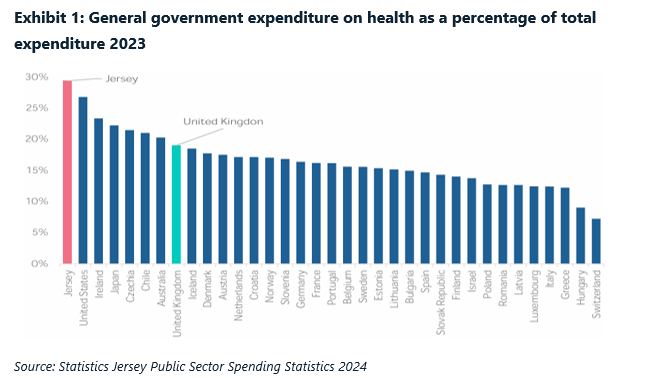
Using the Classification of the Functions of Government (COFOG) system, expenditure on health in 2024 was £515.7 million which represented 29% of total general government expenditure. In 2023 (the last year for which comparative data is currently available) the percentage of total general government expenditure on health was higher than any Organisation for Economic Co-operation and Development (OECD) country and was over 10 percentage points higher than the United Kingdom (Exhibit 1).
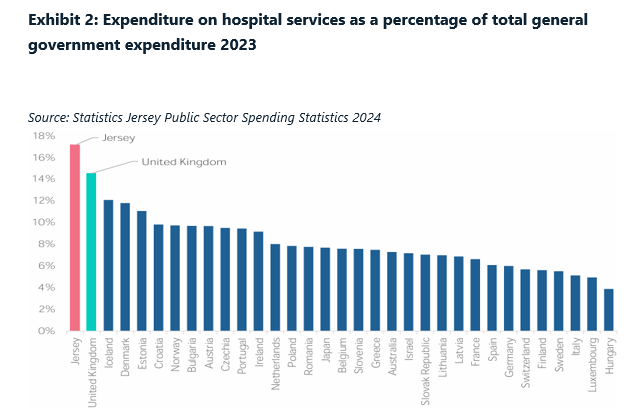
The high level of expenditure in Jersey is driven primarily by the percentage of Government expenditure on hospital services being above all OECD nations (Exhibit 2).
The need to develop a long-term sustainable healthcare funding model, to support wider changes in the healthcare system, has long been recognised. Since 2022 the work that has been undertaken includes the development of a model to underpin future projections in healthcare expenditure.
The Budget 2026-2029 includes two new fees planned to be introduced in 2026 (use of the Emergency Department and Did Not Attend Fees) as well as investment in prevention measures and the digital health strategy. A period of public communications is required prior to the introduction of the Did Not Attend Fees and the Emergency Department Fees require further approval by the States Assembly prior to introduction.
Scope
This audit has assessed the:
- assumptions underpinning the model being developed and the extent to which the model and supporting assumptions will enable effective options appraisal and decision making
- design of the controls supporting the implementation of new fees; and
- extent of progress being made in the development of sustainable healthcare funding in Jersey including by taking learning from previous initiatives.
The audit included consideration of the arrangements and strategies within and available to Health and Care Jersey (HCJ) and across the States of Jersey, including those which relate to current and future assumptions and modelling options.
The audit has not included an assessment of the New Healthcare Facilities Programme. The C&AG is undertaking a separate audit of the New Healthcare Facilities Programme in 2026.
The work undertaken has not included an audit of the Health Insurance Fund or the Long-Term Care Fund. The C&AG published a report on the Health Insurance Fund in February 2026 and published a report on the Long-Term Care Fund in February 2022.
Conclusions
In 2022, the Health Economics Unit (NHS Midlands and Lancashire Commissioning Support Unit) was commissioned to forecast future expenditure and revenue for healthcare provision, assess the drivers of the gap between the two and make recommendations on the way forward. The report produced in September 2023 concluded that by 2043 total healthcare expenditure (including public and private expenditure) was forecast to reach £1,296 million and to be 39.35% greater than the total healthcare revenue. The public financing gap was forecast to be £298 million by 2043.
During 2025 and 2026, Government officers have undertaken work to develop and update the 2023 model. This new model updates the starting expenditure baseline to 2026 and is intended to answer the question ‘If nothing changes in how Jersey provides or funds healthcare, what will the future cost trajectory be?’.
The approach taken to develop the model is sufficiently robust to provide a view of the underlying future cost trajectory, while accepting that it has some limitations and no long-term forecast can be exact, due to the evolving nature of demographics and healthcare delivery. At the time of the fieldwork, the model was due to be subject to external quality assurance and peer review processes which are now ongoing. The model provides a useful starting point for the consideration of future policy options that seek to put in place a sustainable healthcare funding solution.
Without consideration of future policy interventions and without consideration of any changes in cost profiles resulting from the operation of new healthcare facilities, the updated model reviewed as part of this audit showed a compound average growth rate in total healthcare expenditure of 2.97%. This percentage may change following the further external quality assurance and peer review processes that are ongoing.
It is clear from the output of the model that a range of policies and actions will need to be put in place beyond the Health and Care Jersey (HCJ) Financial Recovery Programme in order to fund public healthcare expenditure in a sustainable way.
The Government is developing a suite of ‘charging’ policies designed to change behaviour, target services in the right direction and reduce costs. These policies are intended to influence the choices that patients and carers make when accessing healthcare provision. They are aimed at encouraging the overall better use of healthcare resources and are not intended to generate significant funding.
Without firstly publicly explaining the wider strategic challenges facing the Jersey healthcare system over the next 20 years, this suite of operational policies risks being seen as a series of piecemeal initiatives, rather than part of a wider solution. This creates a risk that Islanders do not understand the importance of the suite of policies in contributing to financial, behavioural and cultural change.
Enforcement of the policies is planned to be relatively ‘light touch’ and there is a risk that implementation of the policies will not have the desired impact either financially or culturally.
In order to obtain the full benefits, future long-term funding (including possible reform) should go hand in hand with wider healthcare and social care reform, to ensure that the future monies spent deliver the best possible value for money. This audit has identified six key areas that need to be considered and addressed in conjunction with one another:
- healthcare system constraints
- social care system constraints
- New Healthcare Facilities Programme
- fragmented health and social care accountability
- how change works in practice; and
- capability and continuity of leadership.
The risk of ever rising publicly funded expenditure on healthcare has been known for a long time. It is not an issue that can be resolved by HCJ or the Government in isolation. The solutions that will be required will need a wider public consensus.
Prioritised action is now required in order to bring forward a range of options for future long-term funding hand in hand with wider healthcare and social care reform.