Background
National Infrastructure are those facilities, systems, sites, information, people, networks and processes necessary for a jurisdiction to function and upon which daily life depends.
Not everything within a national infrastructure sector is judged to be ‘critical’. Jersey’s critical infrastructure can be described as those physical facilities, supply chains, information technologies and communication networks which, if destroyed, degraded or rendered unavailable for an extended period, would significantly impact the social or economic wellbeing of Jersey or affect Jersey’s ability to ensure national security.
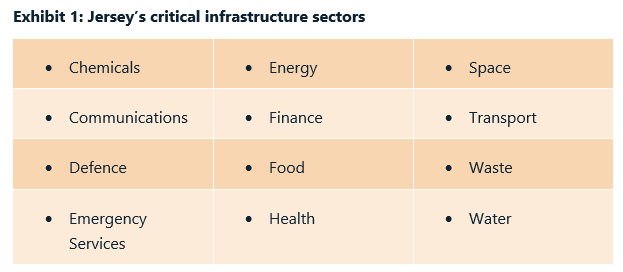
There are broadly twelve sectors that could be considered to be critical infrastructure for Jersey as shown in Exhibit 1.
Critical infrastructure systems within these sectors are particularly vulnerable to being damaged or disrupted.
Ensuring the security and resilience of Jersey’s critical infrastructure is a responsibility shared by the States, infrastructure owners and operators. Each have different responsibilities for critical infrastructure depending on the system and/or the nature of the threats to be mitigated. Responses to a threat can involve the asset owner and operator, the technical and operational lead for Government and emergency services or law enforcement. Co-ordination among entities is therefore required to prepare, rehearse and respond to critical infrastructure threats.
Cyber resilience is the overall ability of systems and organisations to withstand cyber events and, where harm is caused, recover from them. Critical infrastructure systems are prime targets for cyber-attacks due to their vital role in society. Potential cyber security threats do not just affect data and systems in government and business, but also critical infrastructure, including energy, health, transport, water and emergency services.
In October 2017, the Government published its Cyber Security Strategy. The Strategy is centred around the following five pillars:
- Government: Continuously secure Government’s information.
- Critical national infrastructure: Strengthen the critical national infrastructure’s cyber resilience.
- Business: Work in partnership with the private sector to encourage and incentivise improved cyber security across the Island’s businesses.
- Legislation and international engagement: Ensure the appropriate legislation is in place on-Island and engage with the international community to enhance cooperation.
- Citizens: Help ensure people in Jersey are secure online by raising awareness, building cyber skills, knowledge and capability.
To protect the Island, there is a need for Government to work with the private sector and the operators of critical national infrastructure. In addition, there is a need for Government to have robust cyber security arrangements over its own operations.
The Jersey Cyber Security Centre (JCSC) was established in 2021 to promote and improve the Island’s cyber resilience. JCSC is part of the Department for the Economy but operates on an arm’s length basis from Government.
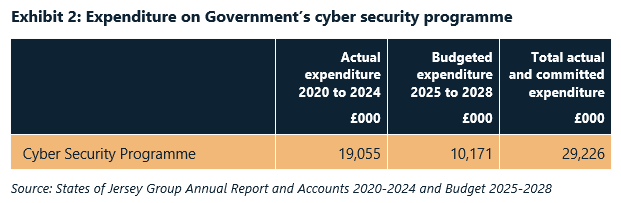
The Government of Jersey has invested and is investing in a cyber security programme focussed on improved protection of Government of Jersey IT systems and related infrastructure to improve its own arrangements. Exhibit 2 summarises the actual and committed expenditure on the cyber security programme within Government.
In May 2022 the C&AG published a report on Cyber Security Arrangements which focussed on the Government’s cyber security programme at that time.
In January 2026 the States Assembly passed a new Cyber Security Law (the Cyber Law). Its objectives are to:
- establish a recognised technical cyber security advisory capability for the Island
- increase the cyber security of network and information systems and operational technology on which the Island’s Operators of Essential Services (OESs) rely; and
- develop a trusted culture of cyber threat information sharing to mitigate cyber risks and raise cyber resilience.
Articles 11 and 20 of the Comptroller and Auditor General (Jersey) Law 2014 make provision for the C&AG to prepare reports arising from her work and forward them to the Greffier of the States to be laid before the States Assembly. Paragraph 65 of the Code of Audit Practice (December 2023) provides that in determining the content and timing of public reporting the C&AG should have regard to potential prejudice to the interests of the States of Jersey or other parties arising from public reporting.
Having regard to this provision and the subject matter of this report, the C&AG has elected to issue a shorter report than usual, excluding her detailed findings and excluding the 23 recommendations arising from her work. The C&AG is, however, providing relevant officers with a supplementary report that sets out more details of the findings to assist them in responding to the recommendations that are included in the supplementary report.
Scope
The audit’s overall objective was to assess whether the Government has an effective approach to cyber resilience.
The scope of the audit included:
- the Government’s cyber security programme
- emergency services and how they are integrated into cyber security governance arrangements
- how operators within the energy sector are integrated into cyber security governance arrangements
- how telecommunications operators are integrated into cyber security governance arrangements; and
- the arrangements in respect of the JCSC.
The audit has not considered arrangements in respect of private sector businesses on the Island.
Conclusions
Key Findings
The Cyber Law sets out clearer expectations for governance, incident reporting, and resilience planning. It also requires stronger co-ordination between government, regulators, and industry.
The UK National Cyber Security Centre (NCSC) has designed a Cyber Assessment Framework (CAF) for organisations who deliver essential functions. The CAF has been used as a basis for the regulatory regime in Jersey.
In April 2025, JCSC was reviewed virtually by the NCSC to conduct an initial evaluation of its process maturity levels. The NCSC produced a summary report which was largely positive towards JCSC in relation to its process maturity and comparison to other small-nation cyber incident response teams.
The Cyber Law will place greater demand on the JCSC given the complexity of the new regulatory regime and the obligations placed on OESs. No additional funding has been provided to the JCSC for implementation of the Cyber Law. The expectation is that current activities can be prioritised to deliver the new requirements and responsibilities.
The C&AG has considered arrangements for cyber security at four OESs and found varying levels of cyber security maturity at these entities. The obligations on these entities has increased under the Cyber Law and all entities reviewed have work to do to ensure compliance with the new obligations placed on them.
Late in 2019, the Government commenced a Government-wide Cyber Security Programme (CSP 1.0), with the bulk of the work planned to be delivered in two, 12-month tranches. Tranche one was originally scheduled for completion by March 2021. However, the COVID-19 pandemic and associated public health measures and restrictions inevitably led to some programme delays at that time. CSP 1.0 essentially ran from 2020 to 2023.
The stated aim of CSP 2.0 was to lift the Government to a maturity score of 3.0 across all National Institute of Standards and Technology (NIST) core functions.
Since CSP 2.0 was established the focus of the team has shifted to address critical operational weaknesses, rather than substantive implementation of defined deliverables. The shift has been as a result of growing global cyber security threats, including threats to Jersey.
The reactive operational posture necessitated by an evolving external threat landscape, has resulted in resource allocation patterns that prioritise immediate threat response over strategic programme execution.
Underpinning these operational and cultural factors is a foundation of technical debt that constrains progress across multiple CSP 2.0 workstreams. The continued dependency on legacy infrastructure slows implementation of CSP 2.0 and increases the complexity of planned initiatives. This has been recognised and the IT Infrastructure Improvement Programme is running in parallel to CSP 2.0 with close coordination between the two programmes.
The onboarding challenges experienced with external contractors, the change in Programme Manager in 2025 and the capacity limitations observed within internal teams (due to the focus on urgent operational cyber issues) have delayed some aspects of the overall CSP 2.0 programme delivery.
Finding
Jersey’s cyber security is being strengthened through the implementation of the new Cyber Security Law and the supporting Framework. It is essential for the States and for Operators of Essential Services to ensure that their arrangements meet the requirements and expectations placed on them under the new Law.
While Government has taken action to improve its own cyber security resilience there remains considerable work to be undertaken to ensure that the arrangements in place meet minimum expected maturity standards.