Background
The States of Jersey have a range of non-Ministerial departments. These are non-executive and legal departments that form part of the public service though sit outside of the government department structure. They are individual bodies that vary in size, have diverse, distinct and important roles and operate under different legislation. Some of the most senior officers within the non-Ministerial departments are Crown appointments.
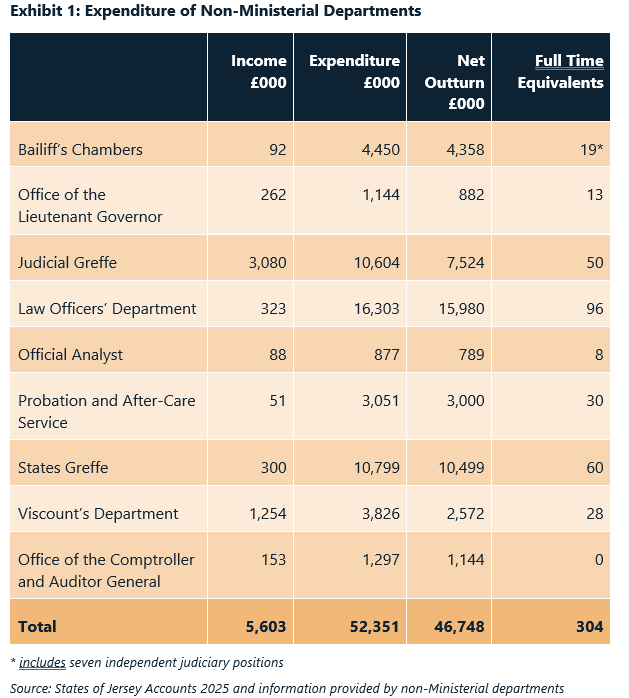
Reflecting their role and statutory provisions, Chief Officers are accountable directly to the States Assembly rather than to Ministers. The expenditure of non-Ministerial departments for 2025 is shown in Exhibit 1.
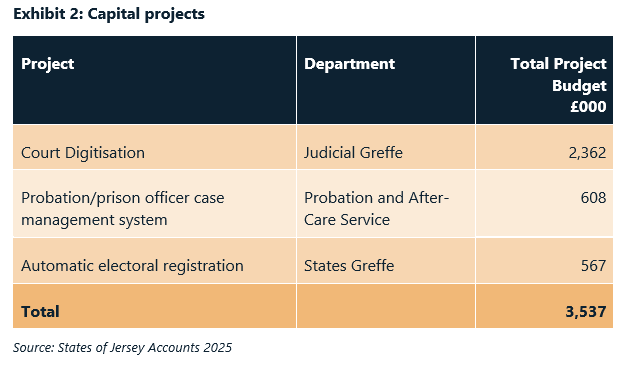
In addition to revenue expenditure there have been a number of capital projects undertaken by the non-Ministerial departments as shown in Exhibit 2.
In 2019 the then Comptroller and Auditor General (C&AG) undertook a review of Non-Ministerial Departments. The review evaluated the arrangements for governance and accountability of non-Ministerial departments, including differences in arrangements between Ministerial departments; and evaluated the effectiveness of support services to non-Ministerial departments and the scope for improvement, including through collaboration.
Scope
The audit’s overall objective was to evaluate how the States of Jersey non-Ministerial departments use their resources to manage risk, and to ensure they deliver an efficient, effective and economic service.
The scope included all non-Ministerial departments with the exception of the Office of the Comptroller and Auditor General and the Probation and After-Care Service. A separate audit of the Probation and After-Care Service has been undertaken and has been reported.
The audit used a:
- results-oriented approach (are the non-Ministerial departments meeting stated objectives and ambitions?); and
- system-oriented approach (are robust systems / processes in place for non-Ministerial departments to support performance and value for money?).
The criteria used for this audit are set out below:
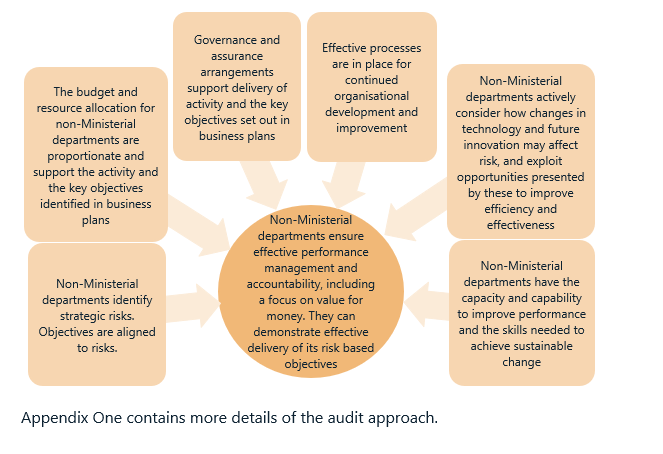
Conclusions
Most non-Ministerial departments set out their objectives in a documented business plan, some of which are published. While some non-Ministerial departments have developed and publish service performance measures, there are opportunities for all departments to enhance the performance measures used to set objectives and performance targets, in particular to demonstrate value for money, and to assess outcomes compared with the targets.
In 2019 the previous C&AG found that risk management was not embedded within non-Ministerial departments. While improvements have been made there continues to be variation in the maturity of risk management across the non-Ministerial departments. There are opportunities to reflect on whether there should be additional formal mechanisms for the escalation of risks that may have significant financial consequences to the Treasurer and/or Treasury and Resources Minister.
Business continuity plans are in place for some non-Ministerial departments, but not all. The Law Officers’ Department, the Viscount’s and the Judicial Greffe all have fully developed plans which are on the Enterprise Risk Management (ERM) system and were tested in 2025. The States Greffe has a Plan that is in the process of being transferred on to the ERM system. The remaining departments have not yet developed business continuity plans or recovery plans.
Some aspects of Royal Court security has been identified as a risk for a number of years, with limited progress being made on the issue.
The budget allocation process followed for non-Ministerial departments is different from Ministerial departments, recognising their constitutional independence. Business cases supporting budget growth are not always detailed enough in documenting the link between the increase in workload and the resource required. In addition, it is not always clear whether budget growth in a year should be treated as ‘one off’ because of changing circumstances in successive years.
Some non-Ministerial departments demonstrate good practice in governance in the preparation and challenge processes associated with annual governance statements. In some instances however I noted little challenge to the Accountable Officer even where non-compliance with the Public Finances Manual (PFM) is evident.
A Non-Ministerial Departments Forum is in place which should act as an important link between non-Ministerial departments and the Government of Jersey. The Forum had not however met at all during 2026 at the time of my fieldwork since the chairmanship of the Forum changed at the end of 2025. I understand that the Forum has now met since my fieldwork with another meeting planned for December 2026
The level of liaison with and support received by the non-Ministerial departments from the central support functions (including Treasury, People Services, Digital Services, Jersey Property Holdings and policy functions) is varied. There remains no clear agreement on the services that the non-Ministerial departments can expect to receive and there is no consistent process for the allocation of some central support services.
A number of the non-Ministerial departments are embracing new technology systems to support their activities. These include the Court digitisation project, the Automatic Voter Registration (AVR) system and a new practice management system being implemented by the Law Officers’ Department. In addition, in the Bailiff’s Chambers and Judicial Greffe, litigation is now paperless and the process of beginning proceedings by buying Jurat stamps has now been replaced by a wholly electronic system. There is also a new jury selection and management system (Tirage) and a new coroner case management system (Civica/iCasework) in the Viscount’s Department.
Some non-Ministerial departments are also exploring how to use Artificial Intelligence (AI) but none have yet progressed AI innovation as part of a major project.
For those non-Ministerial departments with documented workforce plans there are opportunities for enhancement of these plans to document fully the future skills needed for a sustainable workforce and for succession planning. Some non-Ministerial departments were developing their workforce plans further at the time of my fieldwork.
Non-Ministerial departments are in a unique position, within the States of Jersey. While each department operates separately, they have been exploring better ways to work together where objectives are similar and opportunities exist. The efforts that have gone into the Non-Ministerial Departments Strategy Group and the Forum that liaises with the Government, need to be increased and developed to optimise the benefit.
Governance is strong in many non-Ministerial departments. More needs to be done however to develop service performance measures to demonstrate value for money and assess outcomes.