The States of Jersey Fire and Rescue Service (SJFRS) sits within the Department for Justice and Home Affairs (JHA). It has a relatively stable projected annual budget and workforce.
Background
The States of Jersey Fire and Rescue Service (SJFRS) is a key Island workforce responsible for keeping Islanders safe from fires and other emergencies. SJFRS sits within the Department for Justice and Home Affairs (JHA).
In the period from 2019 to 2021 SJFRS saw real terms reductions to its budget. Since 2021, two significant business cases have been approved (one in 2022 and a second in 2025) to invest in SJFRS and to mitigate some of the significant risks that have been identified.
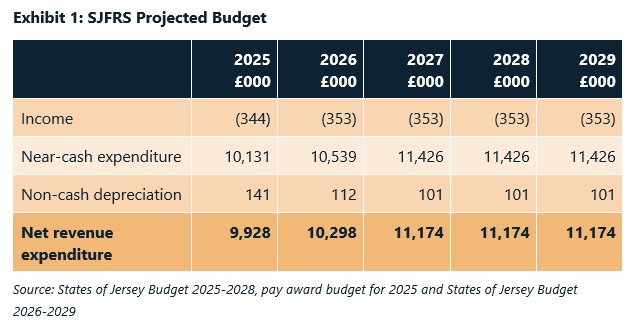
The projected annual budget from 2025 to 2029 is shown in Exhibit 1.
SJFRS is responsible for a broad range of statutory response activities, which includes firefighting, road traffic collisions, hazardous materials, height and entrapment rescues, search, medical co-response and police assistance. It responds to around 1,100 emergencies each year, with the number of emergencies on an increasing trend. SJFRS prevents fires and other emergencies through a risk-based programme of ‘Safe and Well’ visits for older and vulnerable people and community events. It also runs several preventative campaigns throughout the year, including delivery of workplace fire safety training courses. It is also SJFRS’s role to protect people, infrastructure and the environment in higher risk settings through the enforcement of legislation and fire engineering, issuing and renewing fire certificates. The Chief Fire Officer’s legal duties are set out under Article 4 of the Fire and Rescue Service (Jersey) Law 2011.
Scope
The audit has evaluated how well SJFRS uses its resources to manage risk, and to ensure it delivers an efficient, effective and economic service.
The audit extended to:
- the core SJFRS structure, including management of retained firefighters; and
- key partnership agreements and governance arrangements including arrangements with the Minister for Justice and Home Affairs and within the States of Jersey.
The audit considered how the Chief Fire Officer is responding to the Fire Standards and National Operational Guidance but does not provide an assessment of SJFRS against the relevant Fire Standards.
The audit did not evaluate the Emergency Planning responsibilities of the Chief Fire Officer.
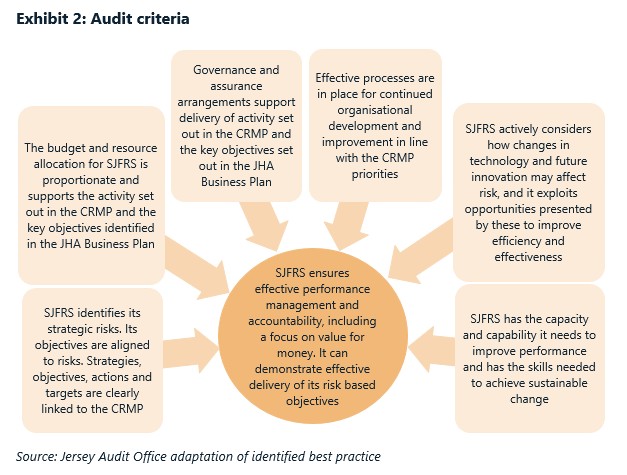
The relative performance of SJFRS was assessed using criteria I have developed from recognised best practices adapted to be proportionate and relevant to the Jersey context.
The criteria are shown in Exhibit 2
More details on the Audit Approach can be found in Appendix One of the Report.
Conclusions
Key findings
The SJFRS Community Risk Management Plan (CRMP) Refresh for 2025 to 2026 sits outside of the JHA Business Plan and identifies the key aims of SJFRS. The CRMP is an extension of the 2021–24 Integrated Risk Management Plan and as such, focusses strongly on operational delivery. It contains less emphasis on measuring other functions such as training, leadership and culture, staffing levels and budget management. The CRMP does not set out clear key performance indicators (KPIs) across all areas of activity. In addition, a lot of actions are labelled as ‘maintain’ or ‘continue’ with no hard targets outlined. A new suite of KPIs has recently been approved which will be integrated into the CRMP 2027–30.
SJFRS has identified a large number of extreme risks, associated with operating at current levels. These extreme risks have been recorded as having a low risk appetite. The mitigations recorded against these risks may not address or improve the risks significantly in the short term. In addition, some of the key dates for implementation appear to be ambitious, and may not be delivered by the deadlines that have been set.
While risks had been identified in SJFRS and raised with the Minister for Justice and Home Affairs in 2021, it was not until 2023 that additional funding was incorporated into the SJFRS budget. This additional funding was approved to increase the workforce and to start to move towards meeting National Operational Guidance (NOG) which is the recognised standard for UK Fire and Rescue services. Since 2022 approved business cases for additional funding have set out the risks clearly.
The financial performance for 2025 shows a marginal overspend position of £35,000 compared to budget. However, there is an underspend of £566,813 on staff costs, an underachievement on income of £4,879 and £596,686 overspend on operational non-pay expenditure. In practice staff vacancy savings have been used to fund non-pay expenditure. In overall terms the budget is not being used to address identified service delivery risks.
The governance arrangements for SJFRS have complex lines of accountability within SJFRS, within JHA and directly to the Minister. An internal review of SJFRS governance undertaken during 2025 identified key areas of strength and opportunities for improvement.
SJFRS considers that it is appropriate for the service to work towards alignment with the NOG. There is still a considerable amount of work that will be required for SJFRS to comply with NOG.
SJFRS has participated in a substantial array of training courses in recent years, both on Island and in the UK, to assist in bridging the significant gaps identified by a 2022 peer review and aimed at bringing SJFRS in line with other services.
SJFRS has been successful in attracting new recruits and at the time of my fieldwork was nearing funded establishment. New officers have been appointed at a senior level from the UK, which should bring additional challenge, experience and expertise to SJFRS. All senior officers have opportunities to take part in leadership training.
Progress on implementing key digital projects has been slow, particularly following the Digital Services prioritisation exercise carried out on digital projects across the States. There is a clear identified risk that key digital projects aimed at mitigating significant risks may not be delivered to timescale.
The risks of not implementing the recommendations of a 2025 Subject Matter Expert review and of not delivering on the emergency control centre project need to be managed carefully given that the weaknesses identified pose risks to public safety, operational performance and compliance.
Conclusion
Since 2022 SJFRS has been strengthening its operations, from a weak foundation. While additional resources have allowed the recruitment of more full time firefighters, including senior officers, much remains to be done to enable a more effective service response and to eliminate occasions where there has been no available capacity.
SJFRS needs to develop and implement a clear strategic plan incorporating all known risks and setting out key objectives, risk mitigations and measurable performance improvement targets. Until such a plan is in place and has been implemented the States continue to demonstrate a high level of tolerance of significant risks.